
Most organizations believe that innovation failure is a resource problem.
- Not enough budget.
- Not enough people.
- Not enough time.
- Not enough leadership attention.
But here’s the uncomfortable truth we see repeatedly across industries.
Companies with strong, well-funded internal R&D teams fail at innovation as often if not more than those without them.
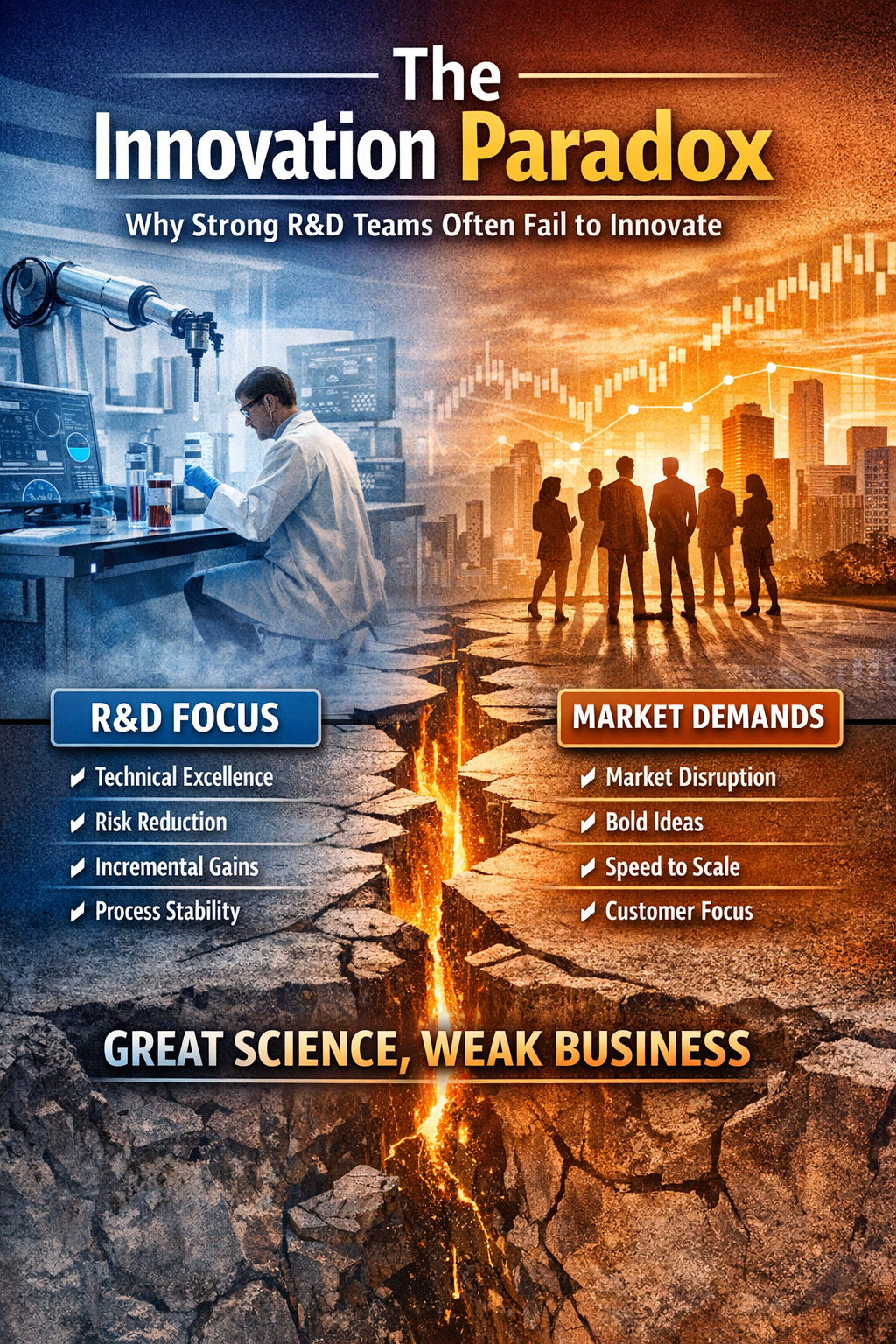
THIS IS THE INNOVATION PARADOX.
The very structures designed to enable breakthrough thinking often end up constraining it.
Internal R&D teams are staffed with smart engineers, scientists, and technologists. They understand the company’s products, processes, and customers deeply. They know what has worked before. They know what cannot be done often better than anyone else.
And that’s precisely the problem.
This argument is not an indictment of R&D teams.
It is an examination of why strong, capable internal R&D teams so often fail to deliver market-shaping outcomes and why external innovation consulting becomes not just useful, but necessary.
Strong internal R&D capability is non-negotiable for any serious organization. However, R&D excellence does not automatically translate into innovation success.
R&D is optimized for:
- Technical feasibility.
- Incremental improvement.
- Risk reduction.
- Process stability.
Innovation, on the other hand, demands:
- Market disruption.
- Business model experimentation.
- Assumption-breaking.
- Managed risk-taking.
These are fundamentally different operating logics.
Expecting internal R&D alone to consistently deliver breakthrough innovation is like expecting a manufacturing line to design its own next-generation factory.
The Core Misalignment: R&D Is Built for Certainty, Markets Are Built on Uncertainty
Internal R&D teams are typically designed to:
- Reduce technical uncertainty.
- Optimize performance metrics.
- Improve existing products and processes.
- Deliver predictable, incremental improvements.
Markets, on the other hand, reward:
- Speed over perfection.
- Directional correctness over precision.
- Customer relevance over technical elegance.
- Timing over completeness.
This fundamental mismatch creates friction.
R&D asks:
“Can we make this work reliably under controlled conditions?”
Markets ask:
“Does anyone care enough to pay for this now or soon?”
When R&D dominates innovation decision-making without strong market filters, organizations end up with:
- Technically impressive solutions.
- Weak value propositions.
- Unclear customer ownership.
- Poor scalability economics.
IN SHORT: GREAT SCIENCE, WEAK BUSINESS.
The 7 Structural Reasons Internal R&D Teams Fail at Innovation
Let’s break this down honestly and systematically.
- Proximity to Legacy Becomes a Blindfold
Internal R&D teams are deeply embedded in:
- Existing product architectures.
- Current customers.
- Installed manufacturing assets.
- Historical success metrics.
This proximity creates cognitive lock-in. Over time, teams unconsciously optimize innovation ideas to:
- Fit current platforms.
- Protect past investments.
- Avoid cannibalization.
- Stay within “what we know works”.
As a result, truly disruptive ideas are often filtered out before they even reach leadership. The most dangerous phrase in innovation is:
“That won’t work in our system.”
- Success is Measured by Activity, not Impact:
Ask most R&D teams how success is measured, and you’ll hear:
- Number of projects initiated.
- Patents filed.
- Prototypes developed.
- Technology readiness levels achieved.
Rarely do you hear:
- Revenue impact
- Time-to-market success
- Adoption velocity
- Unit economics at scale
This misalignment creates a predictable outcome. R&D teams optimize for technical achievement, not commercial success. Innovation becomes something that looks impressive internally but struggles in the real market.
- Pilot Success Is Mistaken for Market Validation
One of the most common failure patterns:
“The pilot worked. The technology is proven.” But pilots are controlled environments. Markets are not. Internal R&D pilots often:
- Run with selected customers.
- Receive internal subsidies.
- Avoid full cost structures.
- Operate outside real-world constraints.
When scaled, these innovations suddenly face:
- Price sensitivity
- Integration complexity
- Operational friction
- Competitive alternatives
And they collapse. Innovation didn’t fail at scale. It was never validated for scale to begin with.
- R&D Is Too Early or Too Late in Strategic Decisions
In many organizations Strategy is decided first R&D is asked to “enable” it later or worse, R&D works independently, and Strategy teams discover innovations too late. In both cases, innovation becomes disconnected from:
- Market timing
- Competitive positioning
- Investment logic
The result?
Great technology searching for a business case or great strategy constrained by outdated technology assumptions.
- Internal Politics Kill Uncomfortable Ideas
Let’s talk about the elephant in the room.
Breakthrough innovation often:
- Challenges powerful business units.
- Threatens existing revenue streams.
- Questions leadership assumptions.
Internal R&D teams depend on those same stakeholders for:
- Budget approvals.
- Career progression.
- Project continuity.
So ideas get softened.
Scope gets reduced.
Ambition gets compromised.
Over time, innovation becomes safe, incremental, and non-threatening which is precisely why it fails to move the needle.
- Ecosystem Myopia
No organization innovates alone anymore. Yet internal R&D teams often:
- Focus inward.
- Build instead of partner.
- Reinvent instead of integrating.
They miss:
- Startup innovation.
- Academic breakthroughs.
- Supplier-led innovation.
- Cross-industry learnings.
Innovation today is as much about orchestration as invention. Without an external lens, internal teams operate in a shrinking universe of ideas.
- Innovation Fatigue and Cynicism
After years of Innovation labs, Hackathons, Proof-of-concepts and “Next big thing” announcements
- Employees begin to disengage.
- Innovation becomes theatre.
- Talented people stop pushing bold ideas.
not because they lack creativity, but because they’ve seen how the story ends.
So rational behaviour emerges.
R&D teams:
- De-risk ideas early.
- Over-engineer solutions.
- Avoid uncertain markets.
- Prioritize technically “safe” paths.
The result is incrementalism masquerading as innovation.
Final Thought: Innovation Is a Leadership Problem, Not an R&D Problem
If innovation is failing, the instinct is often to look downward:
- “R&D isn’t delivering.”
- “Teams lack creativity.”
In reality, innovation outcomes are shaped by:
- Leadership intent.
- Incentive structures.
- Decision frameworks.
- Risk appetite.
R&D teams operate within the system they are given.
Fix the system and innovation follows.
CLOSING QUESTION FOR LEADERS
Before asking:
“Why isn’t R&D delivering innovation?”
Ask instead:
“Have we built an organization where innovation is allowed to succeed?”