Overview
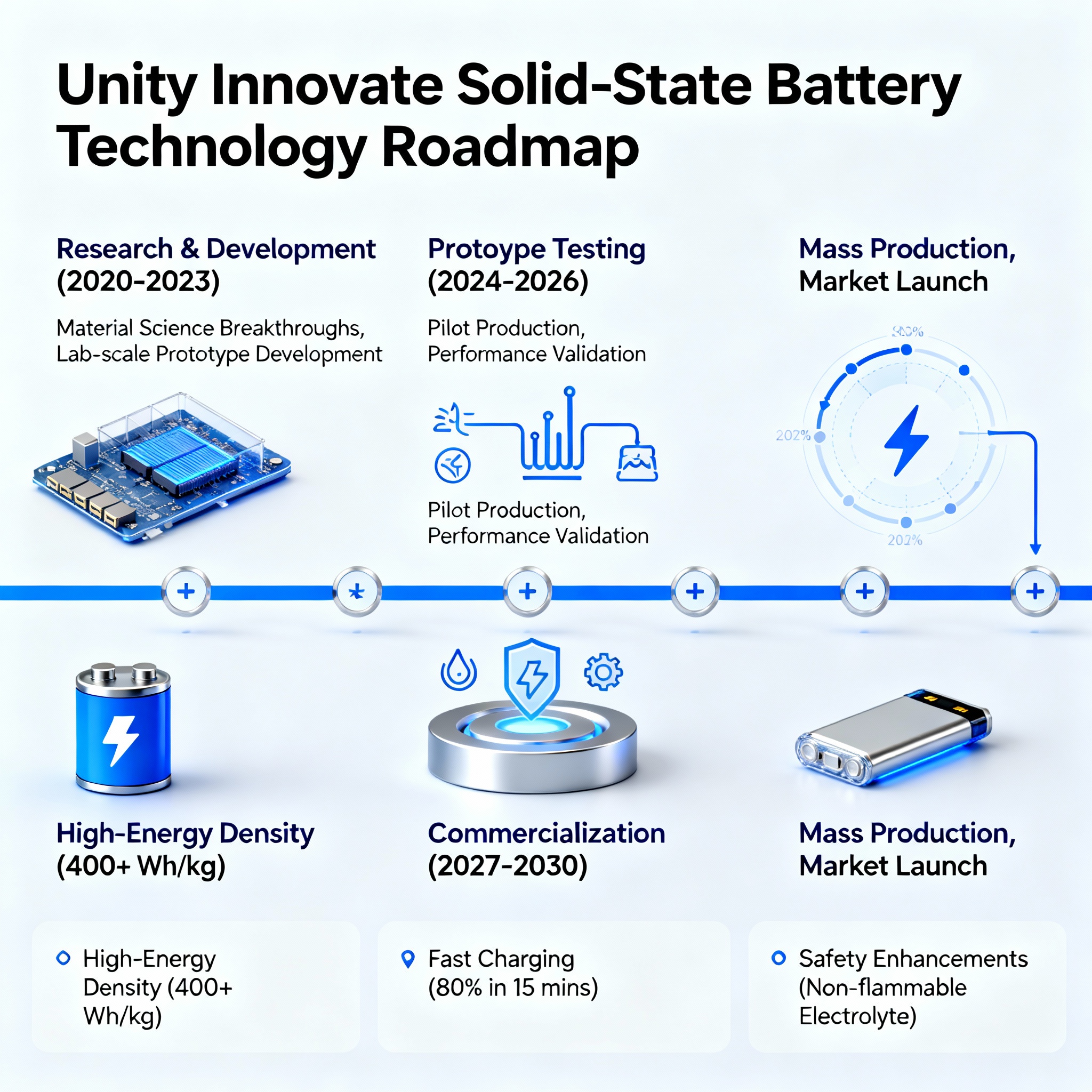
Unity Innovate conducted an in-depth Technology Foresight study on Solid-State Batteries (SSBs) to explore their transformative potential in the global energy storage landscape. This foresight initiative focused on mapping the evolution, innovation drivers, and future opportunities across solid electrolyte technologies including sulfide, oxide, and polymer-based systems — which are poised to redefine safety, efficiency, and performance benchmarks in batteries for electric vehicles, consumer electronics, and grid storage applications.
Industry Context
The global transition to electrification has intensified research into next-generation battery architectures that overcome the limitations of traditional lithium-ion systems. Solid-state batteries, characterized by their solid electrolytes replacing liquid or gel counterparts, promise higher energy density, longer cycle life, and enhanced safety.
With over 85% of global patents filed in the past decade still active, the industry demonstrates an unwavering commitment to SSB innovation. Major OEMs including those in automotive, electronics, power tools, and energy storage are investing heavily to commercialize these technologies.
Technology Shifts and Opportunities
The foresight study revealed key technological shifts in solid electrolyte development:
- Sulfide Electrolytes: High ionic conductivity at lower temperatures, with ongoing research in chemical stabilization and interface optimization.
- Oxide Electrolytes: Excellent structural stability and dendrite resistance, though conductivity remains a challenge.
- Polymer Electrolytes: Flexibility, tunable mechanical properties, and balanced performance across conductivity and stability parameters.
Each electrolyte class presents distinct pathways for market adoption, driven by application-specific demands in performance, safety, and manufacturability.
Innovation Signals and Emerging Research Themes
Unity Innovate identified several weak signals indicating near-future breakthroughs:
- Doping Strategies enhancing ionic conductivity in sulfide materials.
- Nanostructuring Techniques (e.g., sol-gel synthesis, ball milling) improving grain boundary conductivity.
- Interface Engineering to minimize interfacial resistance between electrolytes and electrodes.
- Composite Electrolytes combining polymers and ceramics for improved flexibility and compatibility.
- Additive Manufacturing enabling precise fabrication of complex electrolyte geometries.
These signals highlight a shift toward integrated, multidisciplinary innovation, bridging materials science, process engineering, and manufacturing scalability.
Technology Maturity and Market Readiness
Through Unity Innovate’s Technology Maturity Curve and Hype Cycle analysis, solid-state batteries were positioned in the “Innovation Trigger” stage signaling high research momentum but limited commercial maturity.
However, specific technologies such as LLZO (Lithium Lanthanum Zirconium Oxide) and sulfide-based ceramics have shown substantial progress, moving closer to practical deployment.
Our Opportunity Radar underscored that oxide and polymer composites will dominate mid-term applications, while sulfide systems represent the long-term frontier for high-performance EV batteries.
Ecosystem and Key Players
The universe of active players in this technology domain reflects a dynamic mix of incumbents and disruptors:
- Industry Leaders: Toyota, Samsung SDI, LG Chem — leveraging deep R&D capabilities and vertical integration.
- Innovative Startups: QuantumScape, Ionic Materials — pioneering unique electrolyte chemistries and scalable manufacturing processes.
- Research Institutions: Driving progress in advanced synthesis, doping, and material characterization methods.
This ecosystem indicates a maturing innovation network focused on bridging laboratory research with industrial-scale implementation.
Unity Innovate’s Strategic Insight
Through this foresight initiative, Unity Innovate mapped the strategic innovation pathways that organizations can leverage to stay ahead of the curve in energy storage transformation.
The study highlights how technology monitoring, early signal detection, and cross-industry benchmarking can help businesses align R&D investments with high-impact emerging technologies.
Conclusion
Solid-state batteries stand at the forefront of the energy revolution, embodying the intersection of materials innovation, sustainable energy goals, and industrial scalability. Unity Innovate’s foresight framework continues to empower clients by transforming early-stage insights into actionable innovation strategies, helping them navigate from opportunity identification to market realization.